
Into the 2026 Stretch
📰 Monday, September 21, 2026
Welcome to the FVEr Invest Blog: Your Guide to Data-Driven Market Analysis
Hello FVEr Invest Subscribers!
Thank you to our new and continuing subscribers for your support of our platform. Our goal is to bring you frequent market insights, using our proprietary FVE algorithm to help you gain a clearer understanding of market dynamics.
Disclaimer: The FVEr Invest blog and website should not be construed as specific investment advice, and our approach is not suitable for everyone. It is intended to demonstrate what our algorithmic strategy is doing each week, with insight into how we are thinking about the stock markets, and how we approach investing through a data driven lens. Investing involves risk, and our models are inherently uncertain. Please consult a professional and licensed investment advisor for investment advice.
Disclosure: This blog was written by a human and the ideas are entirely human-generated. The prose was subsequently edited and polished with the assistance of two AI tools, Gemini and ChatGPT.
Into the 2026 Stretch
Market uncertainty has intensified this year, driven by compounding macro and tech pressures. The persistent Middle East conflict continues to inflate oil prices, tariff policy updates under the Trump administration add trade volatility, and ongoing debates surrounding AI's long-term economic and humanitarian impact are front and center in the business pages.
We recommend the podcast episode of the NY Times The Daily from Friday, Sep 18, 2026, which outlines the historical trajectories of the two broad camps of AI theorists stretching back thirty years to the late 1990s.
One camp called the “AI rationalists” believe in a contained and regulated buildout of AI capabilities (Dario Amodei at Anthropic being a member of this camp) because, in their view, only certain companies can be trusted with managing AI infrastructure.
The other camp being the “AI accelerationists” believe in an ungated and open development of the technology to reach intelligent capabilities faster (Jensen Huang at Nvidia, and Mark Zuckerberg at Meta, espouse this approach).
We believe that there will be some regulation of AI soon, due to mounting public pressure about rising utility costs from datacenters and the specter of cybersecurity threats. This may impact markets. A plausible societal-scale AI threat may not resemble the physical autonomous robots portrayed in movies, but rather a diffuse network of AI agents exploiting and coordinating attacks across existing digital infrastructure and the Internet of Things. At a broad scale, it may therefore be naive to think that AI could simply be 'turned off' once it becomes deeply embedded in global digital infrastructure.
Unpredictability has been further amplified by new Federal Reserve Chair Kevin Warsh. In a sharp departure from his predecessor, Warsh has sought to change the Fed's approach to “forward guidance,” arguing that its use should be more limited in normal times. His answers during the press conferences have been brief, and in the most recent meeting, he allowed the press no follow up questions. He has personally opted out of participating in the Statement on Economic Projections (i.e. the “dot plot”) which highlights future target ranges for interest rates and other economic / inflation measures (although the FOMC will continue to publish the projections of other members). We believe this shift could increase uncertainty around the path of future monetary policy. Former Chair Jerome Powell placed a great emphasis on transparency and forward-looking communication. During his tenure, Federal Reserve interest rate decisions were near certain heading into a meeting.
Tech has faced distinct headwinds as well: software-as-a-service (SaaS) stocks suffered a spring "SaaS-pocalypse" in April and May. While software equities have partially recovered, fundamental fears linger over which core applications will be disrupted by advancing AI labs. Software companies once enjoyed formidable moats built around proprietary code, entrenched workflows, switching costs, and accumulated data. Those advantages allowed many software companies to charge premium prices and generate exceptionally high margins.
Despite the wall of worries this year, the US and global markets have done well thus far, and remain over-valued in our view. With this in mind, readers may be confused why our strategies were mostly in leveraged status last week, and this goes back to an important point. We run two parallel indicators: the long term FVE which captures long term trajectories of a market ETF, and a short term 7 week simple moving average (SMA), which captures near term behavior.
Almost all of our strategies were triggered into leveraged status via the 7 week SMA signal, due to the recent declines earlier this month. Thus, we have a long term view that markets will likely go sideways or fall in the next several months, but with near term bounces along the way. This is a common pattern for a drawdown, and we think a net further 5% decline seems reasonable, putting the S&P 500 back down to around the 7,200 mark. This is broadly consistent with our 7,100 year-end target established at the beginning of the year
Structurally, several market factors could account for this.
Strategic Investment Gains vs. Core Growth: Corporate earnings have partially been influenced by increasing valuations among private AI startups (Anthropic and OpenAI). Because hyperscalers hold significant equity stakes in these companies, gains in the value of these holdings can flow through to reported earnings. Crucially, this reflects gains from strategic investments rather than growth generated by core operations. Hard to say if this will continue.
The Year-Over-Year Comparison Trap: Echoing the market dynamics of 2021 leading into 2022, investors remain fixated on year-over-year earnings growth. When growth peaked in 2021 and predictably normalized in 2022, many companies saw their valuations punished. Not because their performance was poor, but simply because it failed to match an unsustainable baseline from the year before. No one knows if the current buildout will continue into next year at the same rate, or if there will be a plateau due to higher borrowing costs from rising long term rates, or AI regulation, for example.
AI regulation is also becoming increasingly politicized. Democratic lawmakers have generally been more receptive to federal AI-safety legislation, while significant Republican opposition remains centered on concerns about regulatory overreach and its potential effect on innovation. The emerging political debate creates an additional source of uncertainty for AI-related equities, particularly if legislation begins to impose meaningful compliance or infrastructure costs. The midterms elections will be a major market catalyst for this reason.
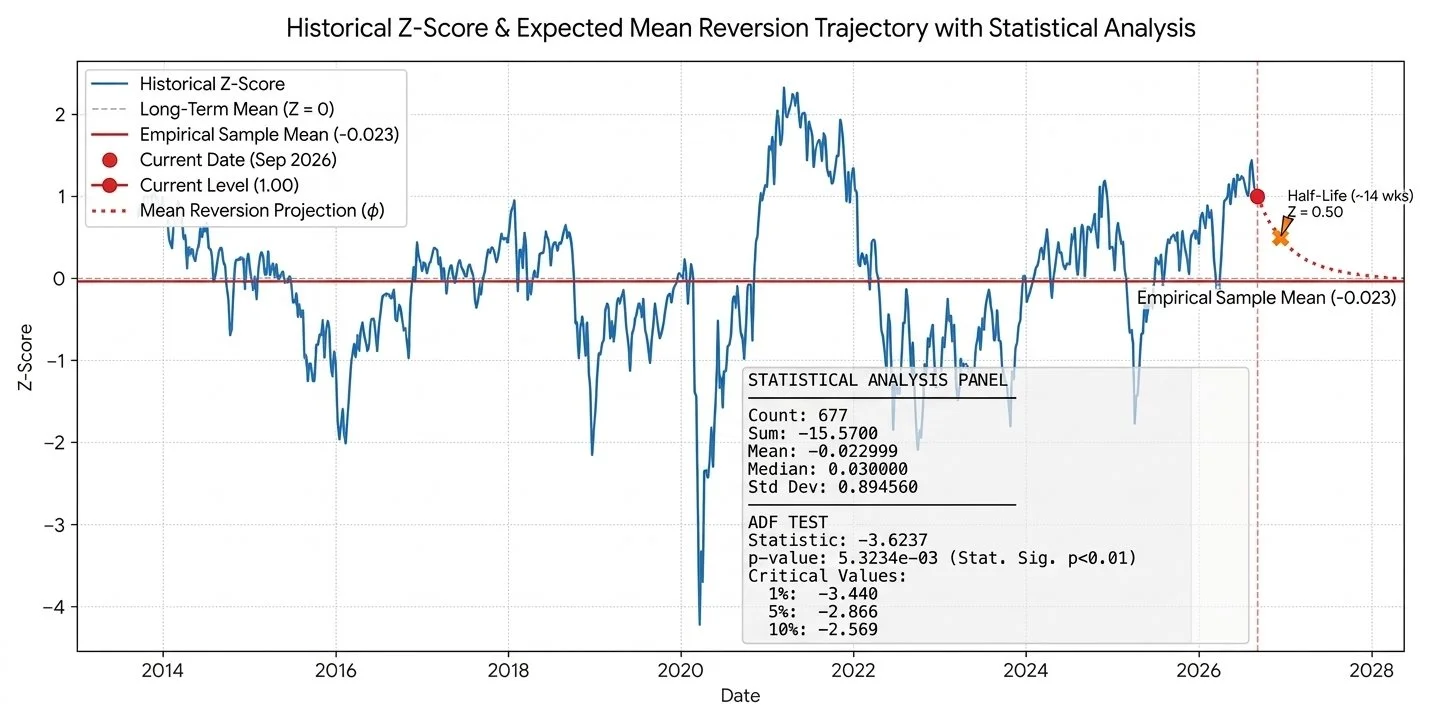
Of course, another reason for our view is our in-house FVE model. We ran this analysis about a week ago, so the data is slightly outdated. In the graphic below, we combine the FVE models for SPY, IJH, and IJR—representing large-, mid-, and small-cap stocks—into a single broad-market model and examine the historical z-scores (normalized deviations from the mean) back to 2014.
We then subjected the resulting series to an Augmented Dickey-Fuller (ADF) test for mean reversion, using Google Gemini to perform the test, and build the graphic. The test produced a p-value below 0.01, providing strong statistical evidence against a unit root and in favor of mean-reverting behavior. The estimated half-life of approximately 14 weeks suggests that, historically, deviations have tended to move back toward their mean over roughly that time frame.
Taken together, the current reading suggests that a decline in the merged z-score toward approximately 0.5 would be consistent with a roughly 4–5% decline in broad markets through year-end. This is broadly consistent with our current market view, although the model is not a prediction and there is no guarantee that historical mean-reversion behavior will repeat.
📈 FVEr Weekly Market Update: Sep 21, 2026
Our strategies are in a multi-week slump. Nearly every ETF is now in leveraged status, which has amplified recent losses. So far we are not concerned, as this pattern is quite common.
Utilities (XLU) has seen an especially sharp sell-off, and our strategy has given back much of last year's gains in that position.
We think a near-term bounce is likely soon, though a further leg down would magnify losses again. Our longer-term view of sideways-to-lower markets is unchanged.
See you next time. In the meantime, please don't hesitate to reach out if you have any questions.
The FVEr Team
Unlock Deeper Insights: Schedule a Learning Session
As a valued member, we encourage you to take advantage of a personalized 30-minute learning session with one of our co-founders. This is your opportunity to get tailored guidance on how to interpret our data and effectively implement our strategies in your own investment approach.
To schedule your session, simply email us at info@fverinvest.com with the subject line: "Learning Session". (Please note: We do not provide specific investment advice.)
