
📰 Monday, November 9, 2026: Welcome to the FVEr Invest Blog: Your Guide to Data-Driven Market AnalysisHello FVEr Invest Subscribers!
Thank you to our new and continuing subscribers for your support of our platform. Our goal is to bring you frequent market insights, using our proprietary FVE algorithm to help you gain a clearer understanding of market dynamics.
Disclaimer: The FVEr Invest blog and website should not be construed as specific investment advice, and our approach is not suitable for everyone. It is intended to demonstrate what our algorithmic strategy is doing each week, with insight into how we are thinking about the stock markets, and how we approach investing through a data driven lens. Investing involves risk, and our models are inherently uncertain. Please consult a professional and licensed investment advisor for investment advice.
Disclosure: This blog was written by a human and the ideas are entirely human-generated. The prose was subsequently edited and polished with the assistance of three AI tools: Claude, Gemini and ChatGPT.
Tech Wreck Continued
What a last week in markets! Technology and AI-related stocks continued their rout last week, culminating in an ~8% single-day drop in the Technology sector (XLK) on Thursday—one of the larger single-day declines in recent history.
What stood out in the underlying data was the intraday nature of the sell-off. Major market drawdowns are typically presaged by severe overnight futures weakness. In this instance, overnight futures were comparatively tame. The prior session actually saw broad-market gains, though semiconductor names still showed underlying friction due to renewed AI growth concerns. By Thursday morning, those fears spread across the broader tech spectrum, driving a severe sell-off almost entirely within standard trading hours that intensified as the day went on.
Tech-centric positions within our aggregate strategy lanes (including SPY, XLK, and QQQ exposure) entered the move in a leveraged status, which erased our accumulated portfolio gains from recent weeks. However, market history demonstrates that high-volatility down days are frequently clustered alongside sharp counter-rally days. Because our quantitative allocation signals re-evaluate on a weekly schedule, we remain leveraged across the technology complex for at least another week. That said, the XLK strategy came within roughly 1% of triggering its volatility threshold to remove leverage, a very rare scenario last seen during the April 2025 tariff crisis.
To put the severity of this sell-off into context, our short-term 35 day SMA residual for XLK has only been lower during two periods in the past decade (the April 2025 tariff crisis and the March 2020 COVID crash). On a short-term basis, we anticipate a notable mean-reversion rally, but nothing is ever guaranteed, especially short term.
Sector Update
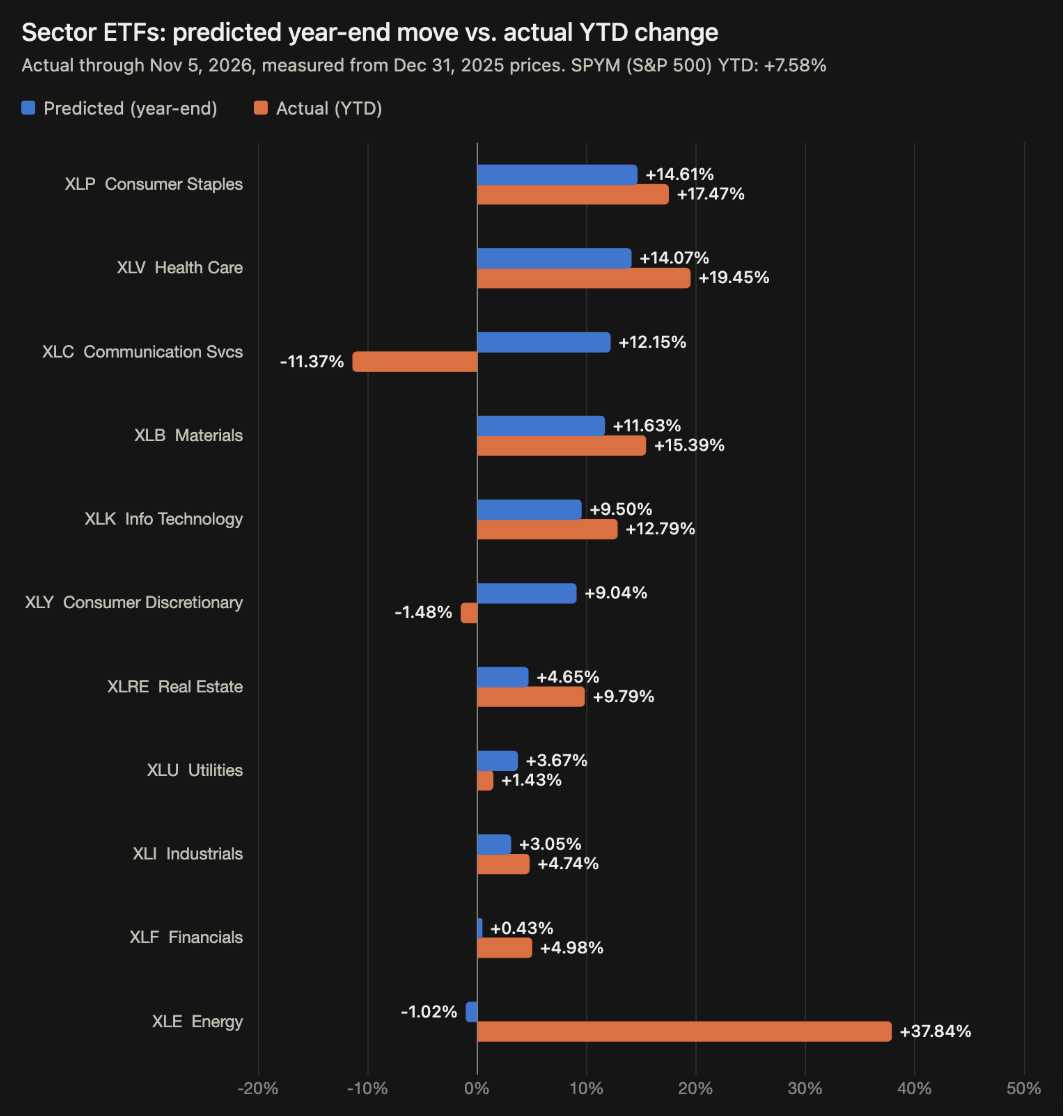
At the beginning of the year, we established year-end 2026 price targets for each of the 11 S&P 500 sectors. The graphic below compares our full-year projections with year-to-date performance. While this represents only a snapshot in time—and several sectors have experienced considerable volatility throughout the year—a few key trends stand out.
Our FVE model identified compelling opportunities in traditionally defensive sectors, particularly Consumer Staples (XLP) and Healthcare (XLV), as well as Materials (XLB), which was emerging from depressed levels in late 2025 amid weakness in the homebuilding industry. These were our top three sector picks, and all three have delivered strong performance. Viewed in aggregate, we believe our model captured the broad direction of the market reasonably well this year.
What continues to amaze us is that these projections were generated entirely from historical price data, without relying on fundamental analysis or subjective assessments of individual sectors. This underscores one of the central ideas behind our approach: historical price trajectories contain meaningful information about future market behavior.
Our most significant forecasting error was Energy (XLE). Modeling this sector with our pricing algorithm remains uniquely challenging given its sensitivity to crude oil prices, which tend to exhibit sharp, non-differentiable movements rather than relatively stable trends. We also did not anticipate a prolonged conflict involving Iran and the resulting disruption to global energy markets. Coming into 2026, global crude oil markets were characterized by a supply surplus, but that dynamic changed dramatically following disruptions to shipping through the Strait of Hormuz. Higher energy prices subsequently created headwinds for Consumer Discretionary (XLY), as increased costs at the pump and renewed inflationary pressures weighed on U.S. consumer purchasing power.
The underperformance of Communication Services (XLC) relative to our price target is also noteworthy. This is a relatively new sector, and its historical pricing behavior has yet to establish a particularly stable trajectory. Accordingly, we have less confidence in its projections than in those of more established sectors.
Nevertheless, we think the sector deserves attention as a potential contrarian opportunity. Several distinct business models face significant structural challenges creating a perfect storm: traditional mobile carriers face emerging competition from satellite-based communications, streaming platforms contend with intensifying competition and rising content costs, and legacy cable and media businesses continue to decline. Meanwhile, Alphabet and Meta face growing questions about the long-term returns on their substantial AI investments. Despite these headwinds, the sector contains several high-quality businesses, including Netflix and Disney (and the above mentioned names), that could offer attractive opportunities.
📈 FVEr Weekly Market Update: November 9, 2026
After another tech wreck last week, positioning in our strategy remains leveraged in the technology exposed sectors (SPY, QQQ, and XLK), as well as the Dow Jones (DIA) and the Russell 2000 (IWM).
Healthcare (XLV) once again looks stretched to the upside and remains in the inverse leveraged ETF, while Industrials (XLI) goes back into leveraged status.
See you next time. In the meantime, please don't hesitate to reach out if you have any questions.
The FVEr Team
Unlock Deeper Insights: Schedule a Learning Session
As a valued member, we encourage you to take advantage of a personalized 30-minute learning session with one of our co-founders. This is your opportunity to get tailored guidance on how to interpret our data and effectively implement our strategies in your own investment approach.
To schedule your session, simply email us at info@fverinvest.com with the subject line: "Learning Session". (Please note: We do not provide specific investment advice.)
